
Keep More Abroad at 29 Countries with No Tax on Foreign Income
In today’s borderless business environment, income is often earned across multiple countries, yet most high-income individuals still pay tax as if their income is entirely domestic. If you’re a high-net-worth individual (HNWI), entrepreneur, or investor earning globally, your tax strategy should be as international as your income.
One of the most overlooked wealth planning strategies is choosing to reside in a country that does not tax your foreign income. This legal and increasingly popular approach is used by business owners, global investors, and internationally mobile professionals to preserve more capital and unlock new opportunities.
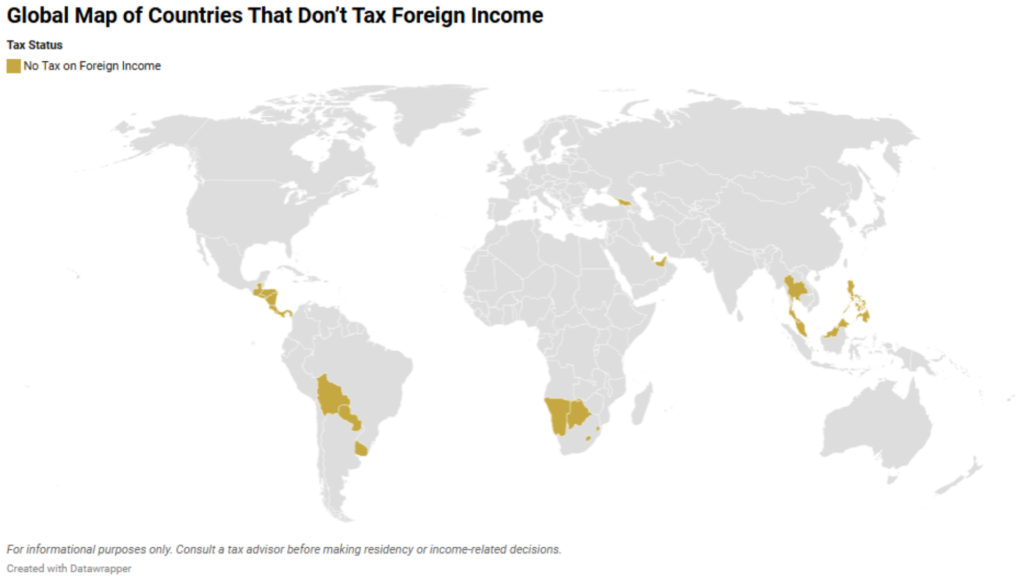
In this guide, we explore 29 countries that, as of 2026, do not tax foreign-sourced income. Whether through territorial taxation, remittance-based exemptions, or full personal income tax elimination, these countries offer significant financial advantages for those with international earnings.
Why Foreign Income Tax Matters
Most countries follow a residency-based tax system, meaning if you’re a tax resident, you’re taxed on all your global income. That includes dividends from offshore companies, rent from foreign properties, remote consulting work, overseas royalties, or interest from international bank accounts.
But some countries choose a different approach, territorial taxation or zero personal income tax. This means that income earned outside the country’s borders is not taxed locally, giving residents a powerful financial edge.
Who Benefits Most from These Tax-Friendly Countries?
- Investors with international portfolios and offshore dividend income
- Entrepreneurs running cross-border or remote businesses
- Consultants and freelancers working with foreign clients
- Digital nomads with global revenue streams
- Retirees with income from foreign pensions or property
- HNWIs managing complex estates and intergenerational wealth
By choosing the right jurisdiction for residency, these individuals can legally reduce their tax burden, simplify compliance, and gain more flexibility in managing their global finances.
How These Tax Systems Work
There are three common systems used by countries that don’t tax foreign income:
1. Territorial Tax System
In a territorial system, the government taxes only income earned within its borders. Anything earned abroad is outside the scope of local income tax. This applies to wages, dividends, capital gains, or business income, so long as it’s sourced internationally.
2. Remittance-Based Taxation
Some countries tax foreign income only when it is brought into the country (remitted). This offers flexibility, as income left offshore remains untaxed.
3. No Personal Income Tax
A few jurisdictions eliminate personal income tax entirely. Residents owe zero tax on both foreign and local income. These are often small island nations or oil-rich economies that rely on other revenue sources.
Understanding which system a country uses is crucial for determining how your global income will be treated and how much you get to keep.
29 Countries Where Foreign Income Is Not Taxed Locally in 2026
These countries either follow territorial tax rules, remittance-based exemptions, or apply no personal income tax at all. Here’s a regional breakdown:
Latin America & the Caribbean
- Panama – Classic territorial tax system. Foreign-sourced income is fully exempt for residents.
- Paraguay – Only local-source income is taxed. Offshore earnings are not subject to domestic tax.
- Costa Rica – Foreign income remains untaxed under its territorial approach.
- Uruguay – Offers a favorable tax regime that excludes foreign income with specific exemptions.
- El Salvador – Foreign-source income is not taxed under its territorial model.
- Guatemala – Income earned outside the country is not subject to local taxation.
- Honduras – Has territorial principles, exempting income earned abroad.
- Nicaragua – Applies tax only to domestic income; foreign income is exempt.
- Bolivia – Territorial tax rules apply; income from outside Bolivia is not taxed.
- Bahamas – No personal income tax of any kind. Foreign and local income are both untaxed.
- Bermuda – Operates with no personal income tax, attracting global professionals.
- Cayman Islands – Known for its zero-tax structure; foreign income is untouched.
- St. Kitts and Nevis – No personal income tax, with investor-friendly policies.
- Antigua and Barbuda – Also tax-free for residents, with investor programs available.
Asia & the Pacific
- Singapore – Territorial tax system. Foreign income is exempt unless remitted into the country.
- Malaysia – Foreign earnings are not taxed unless brought into Malaysia under current rules.
- Thailand – Exempts foreign income if not remitted within the same tax year.
- Philippines – Certain resident statuses allow for foreign income to be exempt.
- Hong Kong – Long-standing territorial regime; foreign income is entirely exempt.
- Micronesia – Foreign-source income is not taxed under its tax code.
- Qatar – No personal income tax, providing a clean tax environment for expats.
Middle East
- United Arab Emirates – Zero personal income tax across all emirates. Popular with entrepreneurs and wealth managers.
Europe & Eurasia
- Georgia – Foreign income is exempt under its territorial model for individuals.
- Malta – Applies a remittance-based system; foreign income is untaxed unless brought into Malta.
- Moldova – Territorial principles apply; foreign income not taxed locally.
- North Macedonia – Offers a source-based tax system excluding income earned abroad.
- Monaco – Has no personal income tax for residents, making it a long-time favorite for HNWIs.
Africa
- Seychelles – Territorial regime; foreign income is not included in the local tax base.
- Namibia – Applies tax only on Namibian-sourced income.
- Botswana – Foreign income is generally excluded under local rules.
- Eswatini – Taxed only on local earnings; foreign income exempt.
- Lesotho – Excludes foreign income from taxation under its tax system.
Beyond Tax: Additional Benefits
While tax efficiency is a key motivator, these jurisdictions also offer other advantages:
- Greater legal and financial privacy
- Political stability and personal safety
- Residency or citizenship programs with global mobility
- Access to offshore banking, investment, and corporate structures
- Lifestyle improvements for families, retirees, or remote workers
The ability to live in a country that aligns with your values and financial goals is a strong incentive for globally minded individuals.
Planning Your Move: What to Know
Before deciding to relocate or invest in one of these countries, consider the following:
1. Residency Requirements
Most countries require a physical presence, investment, or financial contribution to gain tax residency or permanent residence.
2. Home Country Tax Laws
Citizens from countries like the United States may still owe tax on worldwide income regardless of foreign residency. Always confirm how your home country treats foreign-earned income.
3. Local Compliance
Even in tax-friendly countries, local filing requirements, reporting standards, and regulatory frameworks must be followed.
4. Professional Advice is Essential
Tax laws are complex, and mistakes can be costly. It’s critical to consult with international tax professionals, legal experts, and advisors who understand cross-border planning.

The Strategic Case for Going Global
For HNWIs, entrepreneurs, and global professionals, where you earn your income is important, but where you are taxed may matter even more.
By establishing legal residency in a country that does not tax foreign income, you can:
- Legally reduce or eliminate tax on your offshore income
- Protect more of your capital for growth, investment, and legacy planning
- Simplify compliance and reduce reporting obligations
- Improve your quality of life while building financial resilience
The list of tax-friendly countries continues to grow, and with it, the opportunity to build a smarter, more flexible global lifestyle.
Contact us if you are interested in Citizenship by Investment
Our expert advisors will have a 1-on-1 consultation to find the best solutions for you and your family and guide you through the procedure.
Ready to Keep More of What You Earn?
If you’re earning globally but still paying full tax locally, you’re likely leaving money on the table. The good news? You have options.
Explore how strategic relocation, residency or citizenship by investment, and tax-optimized planning can help you protect your wealth, diversify your lifestyle, and keep more of what you earn.
Get in touch with our team for a private consultation. Let’s build your global plan together.
Share this blog
Frequently Asked Questions
Related Articles

Beijing Is Watching Your Wealth; Turkey Offers a Legal Pathway
In an era of rising financial scrutiny, global investors are taking action. Discover why 89% of Chinese HNWIs are exploring…

Ethiopia Introduces 10 Year Golden Visa to Attract Global Investors
Ethiopia’s 10 year Golden Visa signals rising investor confidence in emerging markets. For HNWI and global investors, it offers long…
UK Visa Fee Increase 2026 Signals Changing Global Access for
The UK visa fee increase 2026 signals a shift in global mobility. Rising costs reflect strong demand and growing selectivity….

Kenya China Trade Agreement Strengthens Economic Ties
The Kenya China trade agreement opens duty free access to 98% of exports, strengthening economic ties and investor confidence. For…

Investor Demand Surges Amid Dominica’s Iranian CBI Suspension
Caribbean CBI programs are tightening eligibility, and investors are responding بسرعة. Discover why HNWI are accelerating applications, how Dominica’s recent…

What HNWI Need to Know About St Kitts Public Benefit
The St Kitts and Nevis Public Benefit Option offers HNWI a simple, transparent path to second citizenship. By focusing on…
7 European Tax Regimes Attracting Global Wealth in 2026
European tax regimes are reshaping global wealth strategies in 2026. From Cyprus’ non-dom system to Italy’s €300,000 flat tax, investors…