
Global Oil: Where the World’s Oil Comes From by Region
Introduction
Understanding where the world’s oil comes from by region offers far more than energy statistics. It provides valuable insight into global economic influence, trade flows, and long-term investment stability. For HNWI, business owners, and global investors, energy production patterns often reveal where economic power and capital concentration are developing.
Oil remains one of the most important commodities in the global economy. It fuels transportation networks, supports manufacturing industries, and keeps international supply chains moving. Although renewable energy continues to expand, oil still plays a central role in global economic activity. Therefore, the regions responsible for producing most of the world’s oil naturally gain strategic economic importance.
When investors examine the global energy landscape, they quickly notice that oil production is not evenly distributed. Instead, a few regions dominate supply and influence global markets.
The Global Oil Landscape
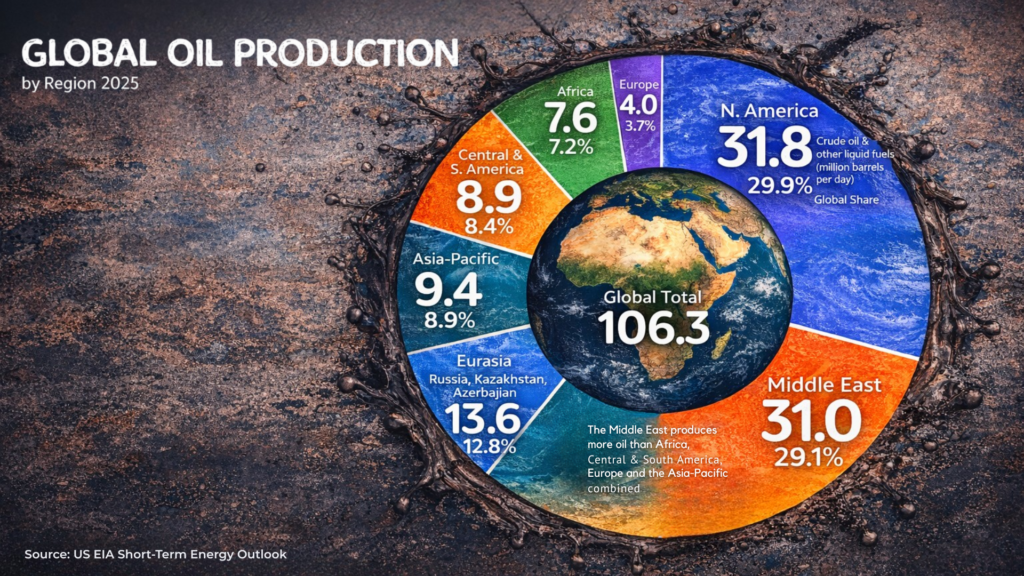
Global oil production continues to concentrate in a handful of regions that hold both large reserves and advanced extraction capabilities. The most notable contributors include:
- North America
- The Middle East
- Eurasia
- Asia-Pacific
- Central and South America
- Africa
- Europe
Among these regions, two stand far above the rest. North America and the Middle East together produce nearly 60 percent of the world’s oil.
This level of concentration highlights an important reality for investors. When key resources cluster in specific regions, economic ecosystems often develop around them. Energy infrastructure expands, financial services strengthen, and global capital begins to follow.
For HNWI and international entrepreneurs, these developments signal where economic stability and strategic opportunities may emerge.
North America’s Rise as a Global Energy Leader
Over the past two decades, North America has transformed the global energy landscape. Technological breakthroughs in drilling and shale extraction have significantly increased production capacity, especially in the United States.
Several factors contributed to this growth:
- Technological innovation in hydraulic fracturing and horizontal drilling
- Strong private sector investment in energy exploration
- Extensive energy infrastructure and transportation networks
- Stable regulatory and financial systems supporting energy development
Canada also plays an important role in the region’s energy output, supported by large oil sands reserves and well-established export infrastructure.
Together, these developments have turned North America into one of the most influential energy regions in the world. The impact extends beyond oil production. The region attracts investment in logistics, refining, energy services, and advanced technologies that support energy efficiency and supply management.
For global investors, these industries create diverse opportunities tied to one of the world’s most strategic sectors.
The Middle East’s Enduring Strategic Importance
While North America has expanded its production capacity, the Middle East continues to hold a central position in the global oil market. The region possesses some of the largest proven oil reserves on the planet.
Several countries dominate regional output:
- Saudi Arabia
- Iraq
- United Arab Emirates
- Kuwait
- Iran
These nations play a critical role in maintaining global energy supply. Their reserves allow them to influence production levels and stabilize markets during periods of economic uncertainty.
Another major factor is geography. The Middle East sits at the center of several key energy shipping routes. Strategic waterways allow oil shipments to move efficiently between Asia, Europe, and other major markets.
Because of this geographic advantage, the region remains a cornerstone of global energy trade and international supply chains.
For investors and business leaders, this stability reinforces the importance of maintaining exposure to regions that influence global commodities and trade flows.
What Oil Concentration Means for Global Investors
The concentration of oil production within a few regions carries broader economic implications. Energy resources shape national revenue streams, infrastructure investments, and financial ecosystems.
Countries with strong energy sectors often experience:
- Increased foreign direct investment
- Expansion of transportation and logistics networks
- Growth in financial services and capital markets
- Greater geopolitical influence
For HNWI and international investors, these trends matter. Markets connected to strong resource sectors often develop robust economic infrastructure and attract global capital.
However, experienced investors also understand the importance of diversification. Concentrated economic power can create opportunities, but it also highlights the importance of maintaining flexibility across multiple jurisdictions.
Global investment strategies increasingly reflect this mindset.
The Growing Importance of Global Mobility
As economic power clusters around strategic regions, internationally minded investors look for ways to maintain flexibility and access to global markets.
Many HNWI now structure their wealth strategies with geographic diversification in mind. Instead of relying on a single jurisdiction, they build international footprints that allow them to live, invest, and operate businesses across multiple regions.
This approach can support several long-term goals:
- Protecting assets from political or economic uncertainty
- Expanding international business opportunities
- Improving access to global financial markets
- Enhancing lifestyle flexibility for families
In this context, investment migration programs have become an increasingly relevant tool for globally minded individuals. These programs allow investors to participate in national economies while gaining residency or citizenship benefits that support mobility and global access.
For entrepreneurs and investors with international interests, such programs often complement broader wealth strategies.

Global Energy Trends and Future Investment Signals
The future of energy will likely involve a combination of traditional resources and emerging technologies. Renewable energy sources continue to expand, yet oil remains essential for transportation, manufacturing, aviation, and heavy industry.
As a result, global oil production will continue to influence economic dynamics for decades.
Several trends will shape the next phase of the energy market:
Energy diversification
Countries are investing in both traditional and renewable energy sources to maintain stability.
Infrastructure development
Energy infrastructure, including pipelines, shipping routes, and refining capacity, continues to expand globally.
Capital investment in energy technology
Advancements in efficiency, storage, and extraction technology will reshape the sector.
Geopolitical shifts
Energy resources remain closely tied to geopolitical influence and global trade relationships.
For investors and business leaders, understanding these trends provides valuable insight into where opportunities may develop.
Energy markets often serve as an early indicator of broader economic changes.
Why This Matters for HNWI and Business Leaders
HNWI and globally active entrepreneurs typically view economic developments through a strategic lens. They seek signals that reveal long-term economic strength, stable jurisdictions, and future investment potential.
The global oil map provides one of those signals.
Regions that dominate energy production often attract significant infrastructure investment, financial capital, and international business activity. Over time, these ecosystems can develop into powerful economic hubs that support innovation and global trade.
At the same time, experienced investors understand the importance of maintaining options. Economic concentration reinforces the value of geographic diversification, allowing investors to adapt to changing global conditions.
For internationally minded families, strategic mobility and access to multiple markets increasingly form part of long-term planning.
Contact us if you are interested in Citizenship by Investment
Our expert advisors will have a 1-on-1 consultation to find the best solutions for you and your family and guide you through the procedure.
Building a Global Investment Perspective
Global markets continue to evolve as energy production, technology, and international trade reshape economic relationships between regions.
Understanding where the world’s oil comes from by region helps investors recognize how global influence develops and where long-term stability may emerge.
For HNWI, entrepreneurs, and international investors, the ability to move capital, operate businesses, and maintain mobility across strong economic regions can provide valuable flexibility in a rapidly changing world.
As global economic power continues to shift, investors who maintain an international perspective may be better positioned to protect and grow their wealth over time.
If you are exploring ways to strengthen your global investment strategy or expand international mobility, our team can help you understand the opportunities available today.
Frequently Asked Questions
Related Articles

Beijing Is Watching Your Wealth; Turkey Offers a Legal Pathway
In an era of rising financial scrutiny, global investors are taking action. Discover why 89% of Chinese HNWIs are exploring…
Rising Restrictions Are Driving Strategic Mobility for Iranian HNWIs
Rising restrictions are reshaping global mobility for Iranian HNWIs. Discover how strategic residency and citizenship planning can protect wealth, ensure…

Ethiopia Introduces 10 Year Golden Visa to Attract Global Investors
Ethiopia’s 10 year Golden Visa signals rising investor confidence in emerging markets. For HNWI and global investors, it offers long…

UK Visa Fee Increase 2026 Signals Changing Global Access for
The UK visa fee increase 2026 signals a shift in global mobility. Rising costs reflect strong demand and growing selectivity….
Kenya China Trade Agreement Strengthens Economic Ties
The Kenya China trade agreement opens duty free access to 98% of exports, strengthening economic ties and investor confidence. For…

Investor Demand Surges Amid Dominica’s Iranian CBI Suspension
Caribbean CBI programs are tightening eligibility, and investors are responding بسرعة. Discover why HNWI are accelerating applications, how Dominica’s recent…

What HNWI Need to Know About St Kitts Public Benefit
The St Kitts and Nevis Public Benefit Option offers HNWI a simple, transparent path to second citizenship. By focusing on…