
Which Passport Offers the Most Reliable Consular Support
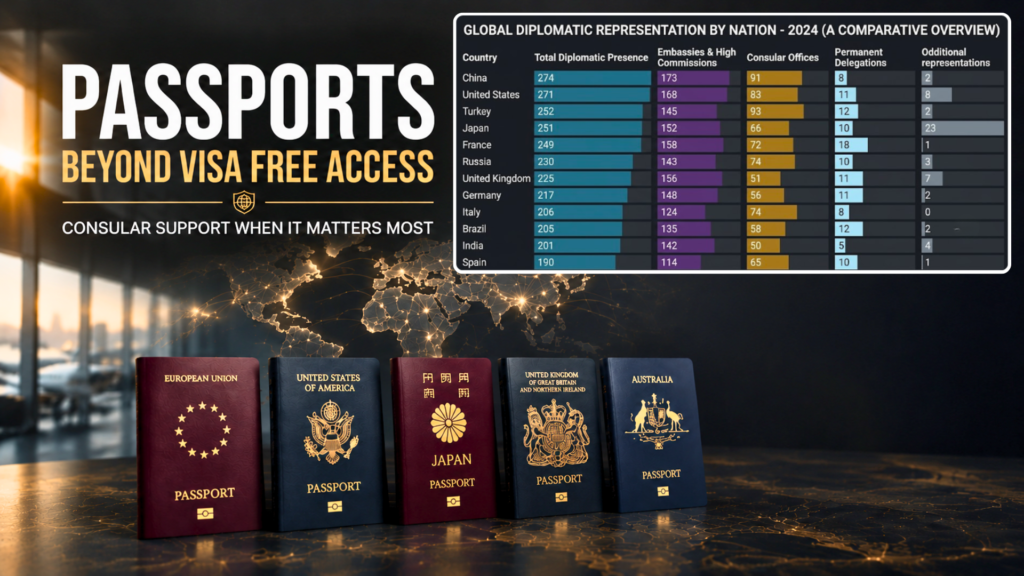
The passport that offers the most reliable consular support does more than provide convenient international travel. It connects its holder to diplomatic assistance during an arrest, serious illness, lost passport, natural disaster, or political crisis. For HNWI, business owners, and investors, this support can protect family security, business continuity, and confidence when operating across borders.
However, no passport provides the strongest protection in every country or situation. Some governments maintain extensive embassy networks, while others provide clearer legal rights to assistance. Large nations may also have stronger crisis response resources, although even they cannot guarantee evacuation or immediate intervention.
Investors should therefore assess consular support as part of a broader global mobility and risk management strategy.
What Does Consular Support Mean?
Consular support refers to the assistance that a government provides, or may provide, to its citizens while they are abroad.
An embassy or consulate may help when a citizen loses a passport, becomes seriously ill, experiences a crime, faces arrest, or needs support during civil unrest. Officials may also provide contact details for local lawyers, interpreters, hospitals, and emergency services.
Consular officers can communicate with local authorities and contact family members when necessary. They may also issue temporary travel documents after confirming a person’s identity and citizenship.
However, consular officials cannot replace local courts, police, doctors, or insurance providers. They cannot overturn local laws, cancel legal proceedings, pay private expenses, or automatically remove someone from a dangerous country.
The level of support depends on the passport country, the location, available resources, local law, and the seriousness of the situation.
Why Consular Support Matters to HNWI
HNWI and business owners often maintain commercial, personal, and financial interests in several jurisdictions. Family members may study abroad, companies may operate in emerging markets, and investment portfolios may require regular international travel.
This exposure creates opportunity, but it also increases risk.
A political dispute can close borders with little warning. A lost passport can delay a major transaction. A medical emergency can leave a family searching for reliable local information. An arrest or legal dispute may require immediate contact with qualified professionals.
Reliable consular support cannot remove every difficulty, but it can create an official communication channel during a stressful situation.
For globally mobile investors, this support can contribute to:
- Greater confidence when entering unfamiliar markets
- Faster access to emergency travel documentation
- Clearer guidance during political or security crises
- Support when communicating with local authorities
- Improved family preparedness
- Stronger international contingency planning
Consular assistance should complement private insurance, legal advice, security planning, and emergency funds. It should not replace them.
How to Assess Consular Reliability
A country with many embassies and consulates can usually provide support in more locations. However, the total number of diplomatic posts does not tell the complete story.
The location of those posts matters.
A business owner with interests in Africa, Asia, or the Middle East should examine whether the passport country maintains active representation in those regions. A large diplomatic network may offer limited value when it does not cover the markets that matter most to the investor.
Investors should also review whether embassies provide emergency telephone services outside normal working hours.
Legal Right to Assistance
Some countries provide consular assistance as a government service rather than a guaranteed legal right. Officials may decide what help they can offer based on security conditions, staffing, local laws, and the individual case.
Other citizenship frameworks provide clearer legal protection.
A legal right does not guarantee a specific result, but it can create stronger procedures and clearer responsibilities. It may also provide access to support from more than one national government.
Crisis Response Capacity
Routine consular services differ greatly from large-scale crisis response.
Replacing a passport may require a consular appointment and identity verification. Evacuating citizens from a conflict zone may require aircraft, ships, security teams, transport agreements, and cooperation with foreign governments.
Countries with larger diplomatic, military, and financial resources may have greater capacity to respond to major emergencies. Even so, they cannot guarantee evacuation from every location.
Airports may close, transport routes may become unsafe, and local authorities may restrict movement. Governments often advise citizens to leave high-risk areas before conditions become critical.
Emergency Document Services
A lost or stolen passport can create serious disruption for an investor with urgent meetings, transactions, or family responsibilities.
Reliable consular systems usually provide a clear process for obtaining an emergency travel document. Investors should assess how quickly officials can confirm identity, whether appointments remain available during emergencies, and what happens when the country has no embassy in the destination.
This practical service can matter as much as broad diplomatic reach.
Why EU Citizenship Offers a Strong Framework
EU citizenship provides one of the broadest formal consular support systems available to international travellers.
When an EU citizen needs help in a country where their own nation has no accessible embassy or consulate, that person may approach the diplomatic mission of another EU member state.
The assisting embassy should generally treat the unrepresented EU citizen under the same conditions as one of its own nationals.
This framework may apply when a citizen faces arrest, serious illness, crime, death, political unrest, or the loss of travel documents.
It does not mean that every EU embassy provides identical assistance. Each member state follows its own national procedures, resources, and service standards. However, the shared framework gives eligible citizens access to a wider network than their national embassy system alone may provide.
EU citizens may also qualify for an emergency travel document when their passport becomes lost, stolen, destroyed, or unavailable. This can help them return home or travel to another approved destination.
For HNWI with international families and business interests, this wider network can strengthen long-term mobility planning.
Do Larger Countries Offer Better Support?
Countries with extensive diplomatic networks often provide strong direct support in many regions. They may have larger teams, more crisis management experience, and greater resources for emergency operations.
However, size does not always equal reliability.
A large embassy may face overwhelming demand during a crisis. A smaller diplomatic mission may offer faster personal assistance in a routine case. Service quality can also vary between locations, even within the same national network.
Investors should therefore compare practical coverage rather than rely only on a country’s global reputation.
The most suitable passport depends on where the family travels, where the business operates, and which risks require protection.

Dual Citizenship Can Create Limitations
Dual citizenship can expand mobility, residence options, and long-term security. However, it can also create consular restrictions.
When a dual citizen enters the country of their other nationality, local authorities may treat that person only as a citizen of that country. Officials from the second passport country may then face limits when requesting access or offering assistance.
Some countries do not recognise dual citizenship at all. Others require citizens to enter and leave using the national passport.
Before travelling, dual nationals should review passport-use rules, military obligations, tax exposure, local laws, and the country’s approach to consular access.
Residency Does Not Equal Consular Protection
Investors must understand the difference between residence status and citizenship.
A residence permit may provide the right to live, work, study, or conduct business in another country. However, it does not usually provide that country’s passport or full consular protection.
For example, residence in an EU country does not automatically create EU citizenship. A resident normally continues to rely on the embassy of their country of nationality.
Some residence programmes can support a future application for citizenship. However, applicants may need to meet physical presence, language, integration, and eligibility requirements before they can naturalise.
Investors should identify whether they need immediate citizenship, secure residence rights, a future naturalisation route, or a combination of these benefits.
Contact us if you are interested in Citizenship by Investment
Our expert advisors will have a 1-on-1 consultation to find the best solutions for you and your family and guide you through the procedure.
Questions Investors Should Ask
Before selecting a second citizenship or residence strategy, investors should ask where the passport country operates embassies, how it handles emergencies, and whether it offers assistance through partner countries.
They should also review the availability of emergency documents, support for family members, dual nationality rules, and the government’s record during international crises.
A credible strategy should reflect actual travel patterns, family needs, business exposure, and long-term plans. It should not depend only on a visa-free travel ranking.
Strengthening Global Security and Mobility
The passport with the strongest practical value will differ from one investor to another. EU citizenship offers a wide shared framework, while larger diplomatic powers may provide greater direct capacity in selected regions. The right choice depends on family structure, business markets, travel frequency, existing nationality, and exposure to political or economic risk.
A professional assessment can determine whether Imperial Citizenship works closely with high net worth individuals, entrepreneurs, and global investors to identify tailored citizenship by investment, residency by investment and solutions that align with long term financial and personal objectives., or a longer naturalisation strategy supports the required level of mobility and protection. Contact our advisory team for a confidential consultation and discover which option may provide the most reliable consular support for long-term global planning.
Frequently Asked Questions
Related Articles
Beijing Is Watching Your Wealth; Turkey Offers a Legal Pathway
In an era of rising financial scrutiny, global investors are taking action. Discover why 89% of Chinese HNWIs are exploring…

Cyprus Foreign Property Restrictions for Investors
Cyprus is considering tighter controls on property purchases by non-EU nationals as foreign demand rises. The proposals could restrict purchases…
China Ends 30-Year Foreign Investor Dividend Tax Exemption
China has ended a tax exemption that protected certain dividend income received by foreign individuals for more than 30 years….

Why 61% of UK Millionaire Investors Consider Moving Abroad
A survey of 341 wealthy UK investors found that 61% have considered becoming resident overseas, while 97% expect taxes to…

Countries Want More Than Tourists. They Want Wealthy Families.
The valuable arrival is no longer just the tourist who spends for a week. Countries are designing residency, tax and…

Europe Is Quietly Killing the Traditional Golden Visa Model
Europe’s familiar property-for-residence model is becoming harder to find. Latvia is removing real estate from its investor residence framework, following…
